


Benefiting From Chaos: How 9/11 Advanced Israel's Agenda

This Article Is An Extension To My Article
-Beyond The Towers: Power, Politics And Israel's Connection-

Photo Cred: RT.com
Everything written below focuses solely on Israel's strategic benefits from the Global War on Terror (GWOT). I deliberately avoid delving into the economic or resource-driven motives behind the conflicts (Excluding Gaddafi's Libya), such as the US control of oil and opium in Afghanistan, the seizure of oil and suppression of Iraq's financial independence from global systems. This analysis centers exclusively on how Israel has advanced its interests through the GWOT, without addressing the roles of Jewish bankers or the broader gains pursued by the United States...
I have excluded Somalia and Yemen from this article. Somalia is omitted due to insufficient evidence connecting it to Israel’s strategic interests. Yemen is excluded because U.S. military actions from 2002 to 2014 contributed to the Houthi takeover in 2014, and the Houthis, as a more significant adversary to Israel than former leaders Ali Abdullah Saleh or Abdrabbuh Mansur Hadi, complicate the narrative of Israel’s strategic gains.
Before we investigate what Israel has gained from the tragic WTC attacks,
I'd like to share this video of the Israeli Prime Minister Benjamin Netanyahu, conveniently predicting the 9/11 false flag right down to the details.
Netanyahu went on to say that "Israel is 'benefiting from the attack' as it 'swung American public opinion."

Now, lets get into it...
As stated above, this article is a continuation of my previous investigation into
Now that we've explored the HEAVY evidence showcasing Israeli involvement, a natural question arises... What could Israel have hoped to gain from orchestrating such a devastating attack on the United States?
Well, this is where the "War On Terror" comes in. (Destabilizing the WHOLE Middle East)
After the September 11, 2001 terrorist attacks on the United States, President George W. Bush announced a comprehensive plan to seek out and stop terrorists around the world.
The wars in Afghanistan and Iraq were part of the Global War on Terror, or “GWOT,” but the term was also used to describe diplomatic, financial, and other actions taken to deny financing or safe harbor to terrorists (Executive Order 13224.)
"Our war on terror begins with al Qaeda, but it does not end there. It will not end until every terrorist group of global reach has been found, stopped and defeated."
-- President George W. Bush, September 20, 2001
War On Terror Targets

-Israel's Clean Break Strategy
A Clean Break: A New Strategy for Securing the Realm-
The "Clean Break: A New Strategy for Securing the Realm" document, crafted in 1996 by a group of neoconservative thinkers led by Richard Perle for then-Israeli Prime Minister Benjamin Netanyahu, is often criticized as a blueprint for aggressive Israeli expansionism and regional destabilization.
Critics argue it embodies a hawkish, imperialist agenda that prioritizes Israeli dominance over Middle Eastern neighbours at the expense of peace and stability. The strategy advocates abandoning the Oslo Accords' "land-for-peace" framework, instead promoting preemptive military actions, regime changes, and proxy wars to neutralize perceived threats like Iraq, Iran, Syria and Lebanon.
Detractors see it as a cynical ploy to entrench Israeli control over Palestinian territories by undermining Palestinian leadership and statehood aspirations, while aligning with U.S. neoconservative interests to reshape the Middle East through chaos and violence. The document’s emphasis on "Western values" is viewed as a veneer for justifying interventions that serve Israeli geopolitical ambitions, often at a devastating human cost, as evidenced by its influence on subsequent conflicts like the 2003 Iraq War and the 2006 Lebanon War.
A Clean Break: A New Strategy for Securing the Realm Document in photo form


A Clean Break: A New Strategy for Securing the Realm
Following is a report prepared by The Institute for Advanced Strategic and Political Studies’ "Study Group on a New Israeli Strategy Toward 2000."
The main substantive ideas in this paper emerge from a discussion in which prominent opinion makers, including Richard Perle, James Colbert, Charles Fairbanks Jr, Douglas Feith, Robert Loewenberg, Jonathan Torop, David Wurmser, and Meyrav Wurmser participated. The report, entitled "A Clean Break: A New Strategy for Securing the Realm," is the framework for a series of follow-up reports on strategy.
Israel has a large problem. Labor Zionism, which for 70 years has dominated the Zionist movement, has generated a stalled and shackled economy. Efforts to salvage Israel’s socialist institutions—which include pursuing supranational over national sovereignty and pursuing a peace process that embraces the slogan, "New Middle East"—undermine the legitimacy of the nation and lead Israel into strategic paralysis and the previous government’s "peace process." That peace process obscured the evidence of eroding national critical mass— including a palpable sense of national exhaustion—and forfeited strategic initiative. The loss of national critical mass was illustrated best by Israel’s efforts to draw in the United States to sell unpopular policies domestically, to agree to negotiate sovereignty over its capital, and to respond with resignation to a spate of terror so intense and tragic that it deterred Israelis from engaging in normal daily functions, such as commuting to work in buses.
Benjamin Netanyahu’s government comes in with a new set of ideas. While there are those who will counsel continuity, Israel has the opportunity to make a clean break; it can forge a peace process and strategy based on an entirely new intellectual foundation, one that restores strategic initiative and provides the nation the room to engage every possible energy on rebuilding Zionism, the starting point of which must be economic reform. To secure the nation’s streets and borders in the immediate future, Israel can:
Work closely with Turkey and Jordan to contain, destabilize, and roll-back some of its most dangerous threats. This implies clean break from the slogan, "comprehensive peace" to a traditional concept of strategy based on balance of power.
Change the nature of its relations with the Palestinians, including upholding the right of hot pursuit for self defense into all Palestinian areas and nurturing alternatives to Arafat’s exclusive grip on Palestinian society.
Forge a new basis for relations with the United States—stressing self-reliance, maturity, strategic cooperation on areas of mutual concern, and furthering values inherent to the West. This can only be done if Israel takes serious steps to terminate aid, which prevents economic reform.
This report is written with key passages of a possible speech marked TEXT, that highlight the clean break which the new government has an opportunity to make. The body of the report is the commentary explaining the purpose and laying out the strategic context of the passages.
A New Approach to Peace
Early adoption of a bold, new perspective on peace and security is imperative for the new prime minister. While the previous government, and many abroad, may emphasize "land for peace"— which placed Israel in the position of cultural, economic, political, diplomatic, and military retreat — the new government can promote Western values and traditions. Such an approach, which will be well received in the United States, includes "peace for peace," "peace through strength" and self reliance: the balance of power.
A new strategy to seize the initiative can be introduced:
TEXT: We have for four years pursued peace based on a New Middle East. We in Israel cannot play innocents abroad in a world that is not innocent. Peace depends on the character and behavior of our foes. We live in a dangerous neighborhood, with fragile states and bitter rivalries. Displaying moral ambivalence between the effort to build a Jewish state and the desire to annihilate it by trading "land for peace" will not secure "peace now." Our claim to the land —to which we have clung for hope for 2000 years--is legitimate and noble. It is not within our own power, no matter how much we concede, to make peace unilaterally. Only the unconditional acceptance by Arabs of our rights, especially in their territorial dimension, "peace for peace," is a solid basis for the future.
Israel’s quest for peace emerges from, and does not replace, the pursuit of its ideals. The Jewish people’s hunger for human rights — burned into their identity by a 2000-year old dream to live free in their own land — informs the concept of peace and reflects continuity of values with Western and Jewish tradition. Israel can now embrace negotiations, but as means, not ends, to pursue those ideals and demonstrate national steadfastness. It can challenge police states; enforce compliance of agreements; and insist on minimal standards of accountability.
Securing the Northern Border
Syria challenges Israel on Lebanese soil. An effective approach, and one with which American can sympathize, would be if Israel seized the strategic initiative along its northern borders by engaging Hizballah, Syria, and Iran, as the principal agents of aggression in Lebanon, including by:
striking Syria’s drug-money and counterfeiting infrastructure in Lebanon, all of which focuses on Razi Qanan.
paralleling Syria’s behavior by establishing the precedent that Syrian territory is not immune to attacks emanating from Lebanon by Israeli proxy forces.
striking Syrian military targets in Lebanon, and should that prove insufficient, striking at select targets in Syria proper. Israel also can take this opportunity to remind the world of the nature of the Syrian regime.
Syria repeatedly breaks its word. It violated numerous agreements with the Turks, and has betrayed the United States by continuing to occupy Lebanon in violation of the Taef agreement in 1989. Instead, Syria staged a sham election, installed a quisling regime, and forced Lebanon to sign a "Brotherhood Agreement" in 1991, that terminated Lebanese sovereignty. And Syria has begun colonizing Lebanon with hundreds of thousands of Syrians, while killing tens of thousands of its own citizens at a time, as it did in only three days in 1983 in Hama.
Under Syrian tutelage, the Lebanese drug trade, for which local Syrian military officers receive protection payments, flourishes. Syria’s regime supports the terrorist groups operationally and financially in Lebanon and on its soil. Indeed, the Syrian-controlled Bekaa Valley in Lebanon has become for terror what the Silicon Valley has become for computers. The Bekaa Valley has become one of the main distribution sources, if not production points, of the "supernote" — counterfeit US currency so well done that it is impossible to detect.
Text: Negotiations with repressive regimes like Syria’s require cautious realism. One cannot sensibly assume the other side’s good faith. It is dangerous for Israel to deal naively with a regime murderous of its own people, openly aggressive toward its neighbors, criminally involved with international drug traffickers and counterfeiters, and supportive of the most deadly terrorist organizations.
Given the nature of the regime in Damascus, it is both natural and moral that Israel abandon the slogan "comprehensive peace" and move to contain Syria, drawing attention to its weapons of mass destruction program, and rejecting "land for peace" deals on the Golan Heights.
Moving to a Traditional Balance of Power Strategy
TEXT: We must distinguish soberly and clearly friend from foe. We must make sure that our friends across the Middle East never doubt the solidity or value of our friendship.
Israel can shape its strategic environment, in cooperation with Turkey and Jordan, by weakening, containing, and even rolling back Syria. This effort can focus on removing Saddam Hussein from power in Iraq — an important Israeli strategic objective in its own right — as a means of foiling Syria’s regional ambitions. Jordan has challenged Syria's regional ambitions recently by suggesting the restoration of the Hashemites in Iraq. This has triggered a Jordanian Syrian rivalry to which Assad has responded by stepping up efforts to destabilize the Hashemite Kingdom, including using infiltrations. Syria recently signaled that it and Iran might prefer a weak, but barely surviving Saddam, if only to undermine and humiliate Jordan in its efforts to remove Saddam.
But Syria enters this conflict with potential weaknesses: Damascus is too preoccupied with dealing with the threatened new regional equation to permit distractions of the Lebanese flank. And Damascus fears that the 'natural axis' with Israel on one side, central Iraq and Turkey on the other, and Jordan, in the center would squeeze and detach Syria from the Saudi Peninsula.
For Syria, this could be the prelude to a redrawing of the map of the Middle East which would threaten Syria's territorial integrity.
Since Iraq's future could affect the strategic balance in the Middle East profoundly, it would be understandable that Israel has an interest in supporting the Hashemites in their efforts to redefine Iraq, including such measures as: visiting Jordan as the first official state visit, even before a visit to the United States, of the new Netanyahu government; supporting King Hussein by providing him with some tangible security measures to protect his regime against Syrian subversion; encouraging — through influence in the U.S. business community — investment in Jordan to structurally shift Jordan’s economy away from dependence on Iraq; and diverting Syria’s attention by using Lebanese opposition elements to destabilize Syrian control of Lebanon.
Most important, it is understandable that Israel has an interest supporting diplomatically, militarily and operationally Turkey’s and Jordan’s actions against Syria, such as securing tribal alliances with Arab tribes that cross into Syrian territory and are hostile to the Syrian ruling elite.
King Hussein may have ideas for Israel in bringing its Lebanon problem under control. The predominantly Shia population of southern Lebanon has been tied for centuries to the Shia leadership in Najf, Iraq rather than Iran. Were the Hashemites to control Iraq, they could use their influence over Najf to help Israel wean the south Lebanese Shia away from Hizballah, Iran, and Syria. Shia retain strong ties to the Hashemites: the Shia venerate foremost the Prophet’s family, the direct descendants of which — and in whose veins the blood of the Prophet flows — is King Hussein.
Changing the Nature of Relations with the Palestinians
Israel has a chance to forge a new relationship between itself and the Palestinians. First and foremost, Israel’s efforts to secure its streets may require hot pursuit into Palestinian-controlled areas, a justifiable practice with which Americans can sympathize.
A key element of peace is compliance with agreements already signed. Therefore, Israel has the right to insist on compliance, including closing Orient House and disbanding Jibril Rujoub’s operatives in Jerusalem. Moreover, Israel and the United States can establish a Joint Compliance Monitoring Committee to study periodically whether the PLO meets minimum standards of compliance, authority and responsibility, human rights, and judicial and fiduciary accountability.
TEXT: We believe that the Palestinian Authority must be held to the same minimal standards of accountability as other recipients of U.S. foreign aid. A firm peace cannot tolerate repression and injustice. A regime that cannot fulfill the most rudimentary obligations to its own people cannot be counted upon to fulfill its obligations to its neighbors.
Israel has no obligations under the Oslo agreements if the PLO does not fulfill its obligations. If the PLO cannot comply with these minimal standards, then it can be neither a hope for the future nor a proper interlocutor for present. To prepare for this, Israel may want to cultivate alternatives to Arafat’s base of power. Jordan has ideas on this.
To emphasize the point that Israel regards the actions of the PLO problematic, but not the Arab people, Israel might want to consider making a special effort to reward friends and advance human rights among Arabs. Many Arabs are willing to work with Israel; identifying and helping them are important. Israel may also find that many of her neighbors, such as Jordan, have problems with Arafat and may want to cooperate. Israel may also want to better integrate its own Arabs.
Forging A New U.S.-Israeli Relationship
In recent years, Israel invited active U.S. intervention in Israel’s domestic and foreign policy for two reasons: to overcome domestic opposition to "land for peace" concessions the Israeli public could not digest, and to lure Arabs — through money, forgiveness of past sins, and access to U.S. weapons — to negotiate. This strategy, which required funneling American money to repressive and aggressive regimes, was risky, expensive, and very costly for both the U.S. and Israel, and placed the United States in roles is should neither have nor want.
Israel can make a clean break from the past and establish a new vision for the U.S.-Israeli partnership based on self-reliance, maturity and mutuality — not one focused narrowly on territorial disputes. Israel’s new strategy — based on a shared philosophy of peace through strength — reflects continuity with Western values by stressing that Israel is self-reliant, does not need U.S. troops in any capacity to defend it, including on the Golan Heights, and can manage its own affairs. Such self-reliance will grant Israel greater freedom of action and remove a significant lever of pressure used against it in the past.
To reinforce this point, the Prime Minister can use his forthcoming visit to announce that Israel is now mature enough to cut itself free immediately from at least U.S. economic aid and loan guarantees at least, which prevent economic reform. [Military aid is separated for the moment until adequate arrangements can be made to ensure that Israel will not encounter supply problems in the means to defend itself]. As outlined in another Institute report, Israel can become self-reliant only by, in a bold stroke rather than in increments, liberalizing its economy, cutting taxes, relegislating a free-processing zone, and selling-off public lands and enterprises — moves which will electrify and find support from a broad bipartisan spectrum of key pro Israeli Congressional leaders, including Speaker of the House, Newt Gingrich.
Israel can under these conditions better cooperate with the U.S. to counter real threats to the region and the West’s security. Mr. Netanyahu can highlight his desire to cooperate more closely with the United States on anti-missile defense in order to remove the threat of blackmail which even a weak and distant army can pose to either state. Not only would such cooperation on missile defense counter a tangible physical threat to Israel’s survival, but it would broaden Israel’s base of support among many in the United States Congress who may know little about Israel, but care very much about missile defense. Such broad support could be helpful in the effort to move the U.S. embassy in Israel to Jerusalem.
To anticipate U.S. reactions and plan ways to manage and constrain those reactions, Prime Minister Netanyahu can formulate the policies and stress themes he favors in language familiar to the Americans by tapping into themes of American administrations during the Cold War which apply well to Israel. If Israel wants to test certain propositions that require a benign American reaction, then the best time to do so is before November, 1996.
Conclusions: Transcending the Arab-Israeli Conflict
TEXT: Israel will not only contain its foes; it will transcend them.
Notable Arab intellectuals have written extensively on their perception of Israel’s floundering and loss of national identity. This perception has invited attack, blocked Israel from achieving true peace, and offered hope for those who would destroy Israel. The previous strategy, therefore, was leading the Middle East toward another Arab-Israeli war. Israel’s new agenda can signal a clean break by abandoning a policy which assumed exhaustion and allowed strategic retreat by reestablishing the principle of preemption, rather than retaliation alone and by ceasing to absorb blows to the nation without response.
Israel’s new strategic agenda can shape the regional environment in ways that grant Israel the room to refocus its energies back to where they are most needed: to rejuvenate its national idea, which can only come through replacing Israel’s socialist foundations with a more sound footing; and to overcome its "exhaustion," which threatens the survival of the nation.
Ultimately, Israel can do more than simply manage the Arab-Israeli conflict though war. No amount of weapons or victories will grant Israel the peace its seeks. When Israel is on a sound economic footing, and is free, powerful, and healthy internally, it will no longer simply manage the Arab-Israeli conflict; it will transcend it. As a senior Iraqi opposition leader said recently: "Israel must rejuvenate and revitalize its moral and intellectual leadership. It is an important — if not the most important--element in the history of the Middle East." Israel — proud, wealthy, solid, and strong — would be the basis of a truly new and peaceful Middle East.
Participants in the Study Group on "A New Israeli Strategy Toward 2000:"
Richard Perle, American Enterprise Institute, Study Group Leader
James Colbert, Jewish Institute for National Security Affairs
Charles Fairbanks Jr, Johns Hopkins University/SAIS
Douglas Feith, Feith and Zell Associates
Robert Loewenberg, President, Institute for Advanced Strategic and Political Studies
Jonathan Torop, The Washington Institute for Near East Policy
David Wurmser, Institute for Advanced Strategic and Political Studies
Meyrav Wurmser, Johns Hopkins University
It's scary how effectively the "Clean Break" strategy unfolded, with the destabilization and regime change of Iraq, Afghanistan, Syria, Libya and beyond aligning eerily well with its vision of reshaping the Middle East through regime change and chaos, all under the guise of securing Israel's regional dominance.
-Afghanistan-
On October 7, 2001, the President announced that the United States had begun military action in Afghanistan.
The initial strikes were against Al-Qaeda terrorist training camps and Taliban military installations.

To expose Israel's gains from the 9/11 attacks, let's start by examining Osama bin Laden's stance on Israel.
Bin Laden strongly hated Israel, viewing its creation as a crime that must be eradicated.
In his 2002 Letter to the American People, he stated that the establishment of Israel was "a crime which must be erased"., and also called for the “annihilation of the state of Israel” in his 1996 and 1998 fatwas.
He was a vocal advocate for Muslim unity, calling for all Muslim countries to come together in solidarity against Western and Israeli aggression. His rhetoric tapped into existing anti-Israel sentiment across the Muslim world, amplifying it through Al-Qaeda’s propaganda networks and inspiring groups like Hamas and Hezbollah, who share a mutual enmity toward Israel.
He viewed the Israeli-Palestinian conflict as a symbol of Western colonialism and a prime example of the oppression of Muslims worldwide.
Bin Laden's ideology emphasized the need for resistance against Israel and its allies, framing it as a religious obligation necessary to counter the systemic destruction of Muslim societies.
He was highly critical of the West, particularly the United States, for its perceived hypocrisy and double standards in supporting Israel while claiming to promote democracy and human rights.
Bin Laden's message resonated with many Muslims who felt disenfranchised and marginalized by Western powers, and he became a galvanizing figure for those seeking to challenge Western dominance and promote Muslim unity.
Bin Laden also had a list of demands centered around the withdrawal of Western influence from the Muslim world. He called for the removal of U.S. military forces from the Middle East, an end to U.S. support for Israel, and the end of Western exploitation of Muslim resources.
Bin Laden demanded the establishment of an Islamic Caliphate (an institution or public office under the leadership of an Islamic steward), governed by Sharia law, and the overthrow of Muslim leaders who collaborated with Western powers.
Furthermore, he sought punishment for perceived U.S. "crimes" in the Middle East, and most notably, the return of Palestinian land to its rightful owners, with the ultimate goal of reestablishing Palestinian sovereignty over Jerusalem and the creation of a fully autonomous Palestinian state, free from Israeli occupation.
Osama Bin Laden's 2002 Letter to the American People (The Guardian) (Images All Taken From The Internet Archive, As Guardian Deleted Their Article When It Went Viral During The Israel-Gaza War 2023)


Here’s a breakdown of what Osama bin Laden discusses in the context of Israel...
The letter addresses U.S.-Israel relations under two main questions: (1) “Why are we fighting and opposing you?” and (2) “What are we calling you to, and what do we want from you?” Below is a detailed breakdown of all mentions and demands related to the U.S. and Israel, presented in the order they appear in the letter, with direct quotes or close paraphrases to ensure accuracy.
U.S. Support for Israel’s Actions Against Palestinians:
Mention: In the section answering “Why are we fighting and opposing you?”, bin Laden lists U.S. support for Israel as the first reason for al-Qaeda’s conflict with the U.S. He states, “The creation of Israel is a crime which must be erased. Each and every person whose hands have become polluted in the contribution towards this crime must pay its price, and pay for it heavily.” He accuses the U.S. of enabling “the Israeli oppression of the Palestinians, the continuous slaughter, the savage beating, the torture, and the destruction of their homes.”
Details: Bin Laden specifies that U.S. support includes providing Israel with “arms and money” used against Palestinians, claiming this contributes to “tyranny, crimes, killing, expulsion, destruction, and devastation.” He asserts that “the blood pouring out of Palestine must be equally revenged,” linking U.S. aid to Palestinian suffering.
Historical Note: The letter was written during the Second Intifada (2000–2005), when Israeli military operations in the West Bank and Gaza, such as Operation Defensive Shield in 2002, responded to Palestinian suicide bombings. U.S. aid to Israel in 2002 was $2.76 billion, including $2.04 billion in military aid and $720 million in economic aid, per Congressional Research Service data.
U.S. Taxpayer Complicity in Funding Israel:
Mention: Bin Laden directly implicates American civilians, stating, “The American people are the ones who pay the taxes which fund the planes that bomb us in Afghanistan, the tanks that strike and destroy our homes in Palestine, the armies which occupy our lands in the Arabian Gulf.” He further claims, “You have supported the Jews in their idea that Jerusalem is their eternal capital, and agreed to move your embassy there.”
Details: He argues that U.S. taxpayers finance Israel’s military actions, specifically mentioning tanks used in Palestine and U.S. support for Israel’s claim to Jerusalem. The embassy reference likely points to the 1995 Jerusalem Embassy Act, which called for moving the U.S. embassy to Jerusalem, though the move occurred in 2018.
Historical Note: In 2002, U.S. aid funded Israeli military equipment, including M60 tanks used in West Bank operations. The Jerusalem Embassy Act, passed by Congress, reflected U.S. support for Israel’s claim to Jerusalem, a contentious issue in the Israeli-Palestinian conflict.
Rejection of Jewish Historical Claims to Palestine:
Mention: Bin Laden denies Jewish historical ties to Palestine, stating, “It is the Muslims who are the inheritors of Moses (peace be upon him) and the inheritors of the real Torah that has not been changed.” He describes Palestinians as “the nation of pure Arabs and original Semites” and dismisses Jewish claims as “fabricated lies.”
Details: He frames the creation of Israel as illegitimate, asserting that Muslims, not Jews, have a rightful claim to the land based on religious and ethnic grounds. This claim appears in the section on why al-Qaeda fights the U.S., tying it to U.S. support for Israel’s existence.
Historical Note: The letter’s publication coincided with heightened Israeli-Palestinian tensions during the Second Intifada, with bin Laden leveraging the conflict to rally anti-American and anti-Israel sentiment.
Demand to End U.S. Support for Israel:
Demand: In the section answering “What are we calling you to, and what do we want from you?”, bin Laden demands that the U.S. “stop your oppression of the Palestinians, and your support for Israel.” He specifically calls for the U.S. to cease “providing both material and moral support” to Israel and end its backing of Israel’s “occupation” of Palestinian lands.
Details: He states, “We call you to… reject the immoral acts of the Americans in their support for the Jews,” urging the U.S. to halt all military and economic aid to Israel. He warns that failure to comply will lead to continued “war” and “destruction,”
framing this as a condition to end al-Qaeda’s attacks.
Historical Note: In 2002, U.S. aid to Israel was a cornerstone of their alliance, with $2.76 billion allocated annually, and the U.S. consistently vetoed UN resolutions critical of Israel’s actions during the Second Intifada.
Conclusion
Osama bin Laden’s “Letter to the American People” explicitly mentions U.S. support for Israel as a primary reason for al-Qaeda’s conflict, accusing the U.S. of funding Israel’s “crimes” against Palestinians through taxes that support tanks and military actions, backing Israel’s claim to Jerusalem, and enabling “oppression, killing, and destruction.” He rejects Jewish historical claims to Palestine as “fabricated lies,” asserting Muslim and Arab primacy. Bin Laden demands that the U.S. stop all material and moral support for Israel, including military and economic aid, and end its backing of Israel’s “occupation.” These points, central to the letter, were written during the Second Intifada, when U.S. aid to Israel was $2.76 billion annually.
-Weakening The Taliban, Al-Qaeda And Ending Osama bin Laden-
The U.S. war in Afghanistan and the broader global war on terror indirectly bolstered Israel’s strategic position by weakening the Taliban and al-Qaeda, whose militant Islamist ideologies had inspired anti-Israel actions worldwide. Al-Qaeda, led by Osama bin Laden, explicitly targeted Israel, framing it as part of a “Zionist-Crusader alliance” and even orchestrated attacks like the 2002 Mombasa bombing against Israeli interests.
The U.S. invasion in 2001 dismantled al-Qaeda’s Afghan bases, disrupted its financing, and scattered its leadership, resulting in bin Laden’s 2011 death, which further eroded its operational capacity. This reduction in al-Qaeda’s global reach limited its ability to inspire or coordinate attacks against Israel, particularly during the Second Intifada when Israel faced heightened threats from Palestinian militants.
The U.S.-led counterterrorism framework, including intelligence sharing and financial sanctions, also aligned with Israel’s efforts to combat jihadist groups, enhancing its security through technologies and tactics developed in the war on terror. By curbing the spread of militant ideologies, the U.S. campaign indirectly shielded Israel from the broader ripple effects of global jihadism, even as it faced localised threats from groups like Hamas.
Simultaneously, the war constrained Iran, a key Israeli adversary, by encircling it with U.S. forces in Afghanistan and later Iraq, diverting its resources from anti-Israel activities. Iran, which opposed the Taliban and supported the Northern Alliance, initially benefited from the Taliban’s fall but soon faced intensified U.S. scrutiny, sanctions, and diplomatic isolation as part of the “Axis of Evil.” This pressure limited Iran’s ability to fund and arm proxies like Hezbollah, which Israel views as a primary threat due to its missile arsenal and proximity in Lebanon. The U.S. military presence in Afghanistan, costing over $2 trillion, also tied up resources that might have supported Iran-backed groups, while sanctions on Iran’s IRGC disrupted Hezbollah’s funding networks.
Furthermore, the war strengthened U.S. ties with Arab states like Saudi Arabia and the Gulf monarchies, who, despite tensions over the Israeli-Palestinian issue, shared Israel’s interest in countering Iran and jihadist groups. These alignments, coupled with U.S. pressure on Iran’s nuclear program, delayed a potential existential threat to Israel and fostered a regional balance that indirectly supported its security objectives, even as Iran’s influence grew in other areas post-Iraq War.
So as you can see, the benefits Israel reaped from eliminating Osama bin Laden, a formidable and outspoken critic of Israel, are not substantial but remain clear.
Various theories suggest that Bin Laden and Al-Qaeda may have been a created and put in place by the CIA, (if so, he played a hell of a role), regardless of the validity of this claim, it’s plausible that his role as an anti-Israel figurehead was initially useful to certain Western interests—perhaps justifying military presence in the Middle East—but became a liability once his influence grew too powerful. His elimination could thus be seen as a calculated move to neutralize a figure whose anti-Israel stance had escalated beyond control.
Following the 9/11 attacks, President Bush demanded that the Taliban, (then governing most of Afghanistan), hand over Al-Qaeda leaders responsible for planning the attacks from within Afghanistan. (Rejected by the Taliban, which then gave the USA the green light to unleash a 20 year war on them)
Notably, the Taliban, a vocal Islamist militant group, (who's given aid to Hezbollah, Iraq and Iran), has consistently opposed the state of Israel, and to this day, refuses to recognise its legitimacy.
-Iraq-
On March 19, 2003, U.S. President George W. Bush ordered the start of war against Iraq. (Because of the time difference, it was early March 20 in Iraq.)
Most people that research 9/11 and Israel's connection, come to the conclusion that Iraq was the main objective and reason for Israel's involvement in constructing the War On Terror...
Let me explain...
The whole 2003 Invasion of Iraq, is based on LIES fed to us by none other than yours truly Benjamin Netanyahu.
On June 12, 1990, (2 months before the gulf war) he appeared on the NBC News Today Show, and spread fear to the American people talking about Saddam's Weapons of Mass Destruction (WMDs) / Nuclear Program. (The first time we heard him speak of Iraq's WMDs... 'Planting the seed')
On September 12, 2002, (one year after he was able to showcase to the world, just how deadly "Islamist Groups" can be, in the form of the WTC attacks.) Benjamin Netanyahu testified to Congress as a private citizen, and straight up lied to Congress, stating that Saddam hadn't given up on his Nuclear dreams and that "Saddam is hell bent on achieving Nuclear weapons as soon as he can."
He even went on and 'guaranteed' that taking out Saddam "would have ENORMOUS positive reverberations on the regime," he then advised Congress that a U.S. invasion of Iraq would be "a good choice."
Please watch the clip I put together below!!!
For those that don't know, there were OBVIOUSLY No Weapons of Mass Destructions found in Iraq. (i.e. 1 million dead in the Iraq war for NOTHING... well not for nothing, if you're Israel.)
Image 1 - (The Guardian) Israel knew Iraq had no WMD, says MP

Image 2 - (The Guardian) There were no weapons of mass destruction in Iraq

Image 3 - (Washington Post) Israel Shares Blame on Iraq Intelligence, Report Says
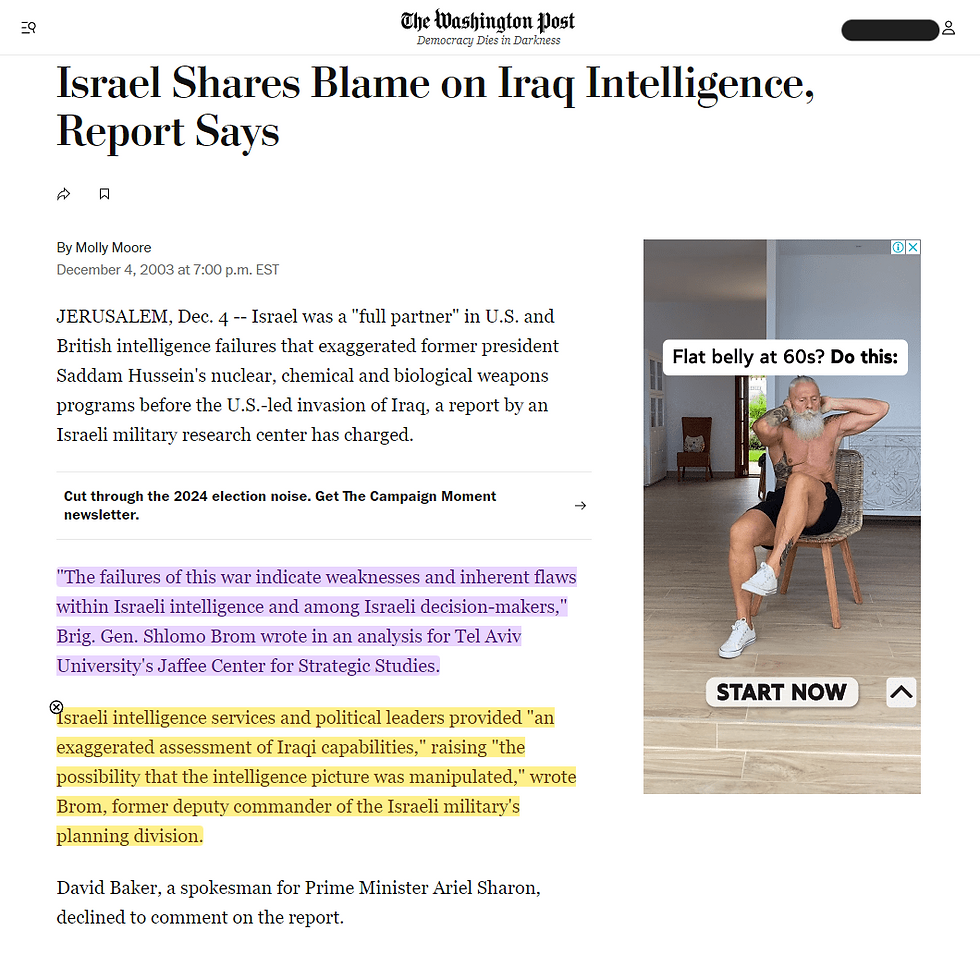

Image 4 - (Washington Post) The Iraq War and WMDs: An intelligence failure or White House spin?


Image 5 - (Vox) Benjamin Netanyahu’s not-so-prescient 2002 message to Congress about Iraq

Now that Israel's role as THE primary motivator for the invasion of Iraq has been established, it's crucial to examine the strategic benefits and advantages Israel gained from manipulating the United States into going to war with Iraq.
-Brief History-
The Iraq–Israel relations refer to the bilateral ties between the State of Israel and the Republic of Iraq. Due to Iraq's non-recognition of Israel as a legitimate state since Israel's establishment in 1948, the two countries have not had any formal diplomatic relations.
Iraq has historically been a persistent threat to Israel, having launched numerous missile strikes and participated in several wars, including the First Arab-Israli War (1948), the Third Arab-Israeli War/Six Day War (1967) and the Fourth Arab-Israli War/Yom Kippur War (1973).
Despite not sharing a border with Israel, Iraq was an important player in the Arab–Israeli conflict. Iraqi troops present in Jordan became involved in the Six-Day War in 1967, suffering 10 dead. The war ended before the Iraqis had time to undertake any serious offensive action.
Iraq played a much more important role in the Yom Kippur War, when it sent 30,000 men, 250–500 tanks, and 700 Armoured personnel carrier (APCs) to the Syrian front just as the Syrians were on the verge of collapse.
Combined Syrian, Iraqi and Jordanian counterattacks prevented the Israelis from advancing further into Syria, but failed to push the Israelis back. The war ended in an Arab defeat, with Israeli forces standing 40km from Damascus.
-Weakening Iraq And Ending Saddam's Regime-
Saddam Hussein stood as an unyielding foe of Israel, denouncing its creation as a Western-engineered violation of Arab sovereignty that demanded its undoing to reclaim regional justice. In his defiant speeches, such as his 1990 warning that Iraq would “burn half of Israel” with chemical weapons IF ISRAEL WERE TO ATTACK IRAQ, he condemned Israel as a predatory outpost fueled by American imperialism.
This vow, a defensive shield against Israel’s history of preemptive strikes, was distorted by Zionist narratives to cast Iraq as a dire threat. Saddam’s rhetoric, amplified through Iraq’s state media, sparked intense anti-Israel views, rallying support for Palestinian groups like the PLO and Hamas, which he armed and sheltered to counter Israel’s relentless expansion.
-Saddam Wanted To Unite Arab Nations-
Image 1 - (LA Times) GRAND DELUSIONS : Arabism: Saddam Hussein is but the latest Middle East leader who would unite the long-divided Arab World--and time is on his side


Saddam was a member of the Ba'ath Party. The Ba'ath party is a secularist Arab nationalism/Pan-Arabism political party opposed to Western imperialism and calling for the "renaissance" or "resurrection" of the Arab World and its unity in one united state.
It's motto "Unity, Liberty, Socialism" (wahda, hurriya, ishtirakiya) — refers to Arab unity, freedom from non-Arab control and interference, and Arab socialism rather than to European socialism, or communism.
As a vanguard of pan-Arab nationalism, Saddam summoned Arab nations to forge a united front against Israel’s oppressive dominance and its Western enablers, positioning Iraq as the spearhead of this noble fight. In the 1970s and 1980s, he convened critical summits in Baghdad, such as the 1978 Arab League conference that denounced Egypt’s treacherous peace with Israel, transforming these assemblies into crucibles for anti-Zionist resistance.
These gatherings united Arab leaders, militant factions, and intellectuals to devise strategies against Israel’s occupation, establishing Iraq as a stronghold of defiance and provoking Israel’s watchful hostility, ever intent on crushing Arab solidarity.
Saddam framed the Israeli-Palestinian conflict as the epicenter of Arab liberation, depicting Israel’s brutal seizure of Palestinian lands as a scar on Arab honor that required unyielding resistance.
His ideology cast opposition to Israel as a sacred mission, exposing the United States hypocrisy for arming Israel while masquerading as a beacon of fairness. This message struck deep chords with oppressed Arab communities, solidifying Saddam’s stature as a hero for those determined to shatter Israel’s chokehold on the region.
His demands were unwavering, anchored in a vision of Arab resurgence. He insisted on expelling Western influence from the Middle East, halting U.S. military and political support for Israel, and toppling pro-Western Arab regimes—like Kuwait and Saudi Arabia—that he accused of aiding Israel’s agenda through their complicity with American forces.
Above all, Saddam championed the liberation of all Palestinian territories, with Jerusalem as the rightful capital of a sovereign Palestinian state, free from Israel’s tyrannical grasp, a cause he bolstered by channeling millions of dollars to the families of Palestinian martyrs during the Second Intifada, a powerful stand against Zionist oppression.
Saddam had long hoped to wage a grinding war of attrition against the Israeli state, and he believed that Iraqi acquisition of a nuclear bomb would neutralize Israeli nuclear threats, force the Jewish state to fight at the conventional level, and thereby allow Iraq and its Arab allies (with their larger economic and population base) to prosecute a prolonged war that would displace Israel from the territories occupied in 1967.
Now, we all know that's something Israel isn't willing to do!!! That's why it shouldn't be difficult to understand why Israel would rather drag the USA and its allies into a 'conventional' war, sacrificing allied lives instead of their own, all for Israeli conquest.
Israel was never going to let Saddam influence neighbour nations in joining him and uniting as one, So faced with the formidable military might of Iraq and its allies, Israel knew it stood little chance of emerging victorious in a direct conflict.
Instead, Israel resorted to its time-tested strategy of manipulating the United States into fighting on its behalf.
By leveraging its considerable influence over Washington, Israel successfully engineered a devastating war that would ultimately lead to the downfall of Saddam Hussein, its archnemesis.
This cynical maneuvering paid off handsomely, as the US-led invasion of Iraq in 2003 achieved Israel's long-sought goal of regime change in Baghdad, and a weakened Iraq.
The removal of Saddam Hussein, who had been a vocal supporter of Palestinian rights and arguably the biggest thorn in Israel's side, was a major strategic victory for Israel.
By outsourcing its military ambitions to the United States, Israel cleverly avoided the risks and consequences of a direct war with Iraq, while still achieving its desired outcome. This calculated move underscored Israel's mastery of realpolitik and its willingness to utilize its considerable influence over US foreign policy to advance its own interests, regardless of the costs to others.
-How Israel 'won over' Washington-
Were duped by a shadowy ‘‘neo-con cabal’’ to do Israel’s bidding and invade Iraq.
It was the so called neo-conservatives in the administration notably,
Paul Wolfowitz (then Deputy Secretary of Defense),
Douglas Feith (then Undersecretary of Defense for Policy),
Elliott Abrams (then in charge of Near East and North African Affairs on the National Security Council),
I. Lewis ‘‘Scooter’’ Libby (then the vice president’s chief of staff),
David Wurmser (an aide to then-Undersecretary of State for Arms Control and International Security John Bolton and later Middle East adviser to Vice President Cheney),
Richard Perle (then chairman of the Pentagon’s Defense Policy Board),
William Kristol (then Writer and former Chief of Staff to the Vice President of the United States)
Robert Kagan (co-founder of the neoconservative Project for the New American Century)
Who were really behind the decision to go to war.
These individuals, all Jewish and all strong supporters of Israel, steered the United States into invading Iraq for Israel’s benefit.
As the right-wing commentator Pat Buchanan (2003) wrote, ‘‘What these neoconservatives seek is to conscript American blood to make the world safe for Israel.’’
Hence, according to this view, the Iraq war had nothing to do with the interests of the United States and every-thing to do with the interests of Israel. It was, quite simply, nothing more than a ‘‘war for Israel’’ concocted by Israel and its American backers.
Copied From:
Arthur Greenwood - The TRUTH About Saddam Hussein
-Establishing Isis-
Brief History
Originating in the Jaish al-Ta'ifa al-Mansurah founded by Abu Omar al-Baghdadi in 2004, the organisation (primarily under the name Islamic State of Iraq) affiliated itself with al-Qaeda in Iraq and fought alongside them during the 2003–2006 phase of the Iraqi insurgency.
The group later changed their name to Islamic State of Iraq and Levant for about a year, before declaring itself to be a worldwide caliphate, called simply the Islamic State
(الدولة الإسلامية, ad-Dawlah al-Islāmiyah)
Copied From:
As evidenced by historical records, the true genesis of the Islamic State of Iraq and Syria (ISIS) can be traced back to 2004, in the aftermath of the US-led invasion of Iraq that overthrew Saddam in 2003.
Contrary to the widely perpetuated official narrative, which suggests that ISIS emerged in 2013, the group's evolution was, in fact, a direct consequence of the power vacuum created by the US invasion.
The US-led coalition's dismantling of Saddam Hussein's regime and the subsequent dismantling of the Iraqi army created a fertile ground for extremist groups to flourish.
The insurgency that followed, coupled with the marginalization of Sunni communities by the Shia-dominated Iraqi government, provided a fertile recruitment ground for jihadist organizations.
One such organization was Al-Qaeda in Iraq (AQI), founded by Abu Musab al-Zarqawi in 2004. AQI would eventually morph into the Islamic State of Iraq (ISI) in 2006, and later, following the Syrian Civil War, into the Islamic State of Iraq and Syria (ISIS) in 2013.
The official narrative's focus on 2014 as the starting point of ISIS overlooks the group's gradual evolution and the critical role played by the US invasion in creating the conditions for its emergence.
ISIS = Israeli Secret Intelligence Service?
The idea that Israel, alongside Western intelligence agencies like the CIA and MI6, played a pivotal role in the creation and operation of ISIS is a perspective that has been increasingly voiced in certain geopolitical circles.
Drawing on various reports and testimonies, these claims paint a picture of a covert operation designed to destabilize the Middle East for strategic gains, suggesting that ISIS is, in part, a product of Israel's hidden agenda in the region.
Mossad and Western Intelligence Agencies Created ISIS?
One of the most vocal proponents of the theory that Israel helped create ISIS is Iran, whose former Intelligence Minister, Heydar Moslehi, publicly accused the Mossad, MI6, and the CIA of being behind the formation of the terrorist group.
In 2014, Moslehi suggested that these intelligence agencies, motivated by their own political interests, played a central role in the creation of ISIS as part of a broader scheme to manipulate and destabilize the Middle East. According to this view, ISIS was not an organic movement but a manufactured entity, designed to serve the interests of Western and Israeli intelligence agencies.
Reports from Iranian media have fueled these claims, citing instances where arrested ISIS operatives allegedly had links to Israeli intelligence. For instance, in 2022, Iranian authorities claimed that ISIS militants captured in the region had direct connections to Mossad.
One particular case that has attracted attention is that of a captured ISIS preacher in Libya, Benjamin Efraim, who was caught working as a Mossad agent. Efraim’s alleged role as an ISIS leader in disguise has added fuel to accusations of Israeli involvement in the creation and spread of ISIS.
By embedding agents within ISIS, Israel could allegedly further its geopolitical goals by destabilizing governments it perceives as threats or by leveraging the chaos for strategic advantage.

Cited From:
Israel’s Support and Aid to ISIS
While there is no concrete evidence of direct Israeli collaboration in the creation of ISIS, there are numerous reports and credible allegations pointing to Israel’s direct involvement in supporting the group.
Reports suggest that Israeli military units provided medical treatment to ISIS fighters. In some cases, wounded ISIS militants have been transported to Israeli hospitals for care. These actions, have been interpreted by many as a form of tacit support for ISIS, particularly in a context where Israel is deeply concerned about the growing influence of Iran in Syria.
Furthermore, analysts have highlighted Israel’s broader strategy in the Middle East, which involves supporting groups that can serve as proxies to destabilize adversarial regimes.
By allegedly aiding groups like ISIS, Israel could weaken governments in Syria and Iraq, as well as Iranian-backed militias.
Cited From:
U.S. and Israeli Funding of ISIS
The role of the United States in the rise of ISIS is well documented, particularly through the U.S.'s support of rebel groups in Syria, some of which eventually became part of ISIS’s ranks.
However, the role of Israel funding ISIS remains a deeply contentious issue. Critics argue that Israeli support for extremist factions in Syria extends to covert assistance that enables ISIS to continue its operations.
Some reports claim that Israel has provided ISIS with funding and arms supplies, through intermediaries and rebel groups, to ensure the group’s survival as a destabilizing force in the region.
Israel has long been accused of taking a pragmatic approach to regional conflicts, including forming alliances with groups and factions that may not align with its long-term goals but can provide short-term benefits, such as weakening its enemies.
In this context, the rise of ISIS and the chaos it caused in Syria and Iraq may have been seen by some Israeli officials as an opportunity to further its interests by indirectly fostering instability.
But, I truly believe that ISIS is short for Israeli Secret Intelligence Service...
Cited From:
ISIS and Israel: A Selective Enemy
One of the most compelling aspects of the Israel-ISIS connection is the fact that ISIS has never attacked Israel directly, despite its brutal campaign of violence against countless other nations, and their sworn war on democracy.
According to an article from The Times of Israel, ISIS has consistently avoided targeting Israel, citing the belief that the group’s main goal is to focus on “Shia” enemies and not to engage with the Jewish state directly.

Yet, this explanation is deeply questionable given the nature of ISIS, a group known for its radical, sectarian violence and willingness to attack anyone it deems an enemy of its so-called caliphate.
In 2017, however, ISIS militants launched an attack against Israeli soldiers on the Golan Heights. After the failed assault, the ISIS fighters reportedly apologized in a public statement, explaining that the attack was a "mistake" and that they had not intended to target Israel.
This extraordinary admission has raised significant suspicions. Why would ISIS, a group with a declared mission to destroy the West and its enemies, suddenly express remorse for attacking Israel?

This bizarre contradiction suggests a deeper, more deliberate calculation at play, one that aligns more with the interests of Israel rather than with the group’s declared purpose of jihad against all non-Muslims, including Jews...
Cited From:
Julian Assange And US General: CIA, Mossad, M16 Created ISIS
According to whistleblower Julian Assange, the CIA, Mossad and M16 played a significant role in the creation of ISIS, using the group as part of its strategy to destabilize the Middle East.
In a statement to coincide with the release of the cables, known as “Carter Cables III”, Assange explained how events which unfolded in 1979, had begun a series of events that led to the rise of ISIS.
He said: “If any year could be said to be the “year zero” of our modern era, 1979 is it.”
Assange said a decision by the CIA, together with Saudi Arabia, to plough billions of dollars into arming the Mujahideen fighters in Afghanistan to tackle the Soviet Union, had led to the creation of terror group al-Qaeda.
This, in turn, he said led to the 9/11 terror strikes, the invasion of Afghanistan and Iraq by the US, and the creation of ISIS.
“ISIS got started through funding from our friends and allies. Because as people will tell you in the region that if you want somebody who will fight to the death against Hezbollah, you don’t put out a recruiting poster saying, ‘sign up for us. We’re gonna make a better world.’ You go after zealots and you go after these religious fundamentalists. That’s who fights Hezbollah. It’s like a Frankenstein.”
Cited From:
https://www.express.co.uk/news/world/737430/CIA-ISIS-Wikileaks-Carter-Cables-III-Julian-Assange
https://muslimmirror.com/cia-created-isis-says-julian-assange-as-wikileaks-releases-500k-us-cables/
https://americanfreepress.net/general-blows-whistle-on-islamic-state/#google_vignette
https://theweek.com/articles/444103/america-created-islamic-state-iraq-syria-meet-isis-truthers
Edward Snowden Documents reveal that American, British and Israeli intelligence agencies worked together to create ISIS.
(Unknown If 100% Released By Snowden - 'Fact Checked' By PolitiFact)
The former employee at US National Security Agency (NSA), Edward Snowden, has revealed that the British and American intelligence and the Mossad worked together to create the Islamic State of Iraq and Syria (ISIS).
Snowden said intelligence services of three countries created a terrorist organisation that is able to attract all extremists of the world to one place, using a strategy called “the hornet’s nest”.
NSA documents refer to recent implementation of the hornet’s nest to protect the Zionist entity by creating religious and Islamic slogans.
According to documents released by Snowden, “The only solution for the protection of the Jewish state “is to create an enemy near its borders”.
Leaks revealed that ISIS leader and cleric Abu Bakr Al Baghdadi took intensive military training for a whole year in the hands of Mossad, besides courses in theology and the art of speech.

Copied From:
What's The Strategic Purpose of ISIS for Israel?
The question then arises: Why would Israel engage in the creation of a group like ISIS? Many theorist argue that such actions align with Israel’s broader strategy of manipulating regional conflicts to secure its dominance in the Middle East.
By fostering chaos and instability, Israel could undermine governments and movements that challenge its interests. ISIS, with its extremist ideology and brutal tactics, serves as a convenient tool to escalate Islamophobia globally, reinforcing negative stereotypes and diverting attention away from Israel's policies in the region.
Destabilizing the Middle East also aligns with Israel’s goal of overthrowing Muslim leaders who oppose its agenda. Governments in Syria, Iraq, and Iran, which have historically resisted Israeli policies, have been primary targets of ISIS’s violence. This chaos weakens potential adversaries and ensures that no unified opposition emerges to challenge Israel's geopolitical interests.
Locally, it will help facilitate the Zionist dream, from the Nile to the Euphrates, “Greater Israel.” A controversial idea suggesting territorial expansion into parts of neighboring countries. By fragmenting and destabilizing these nations, Israel could potentially advance its long-term strategic objectives without direct military engagement.
Additionally, the rise of ISIS has drawn the United States into prolonged military interventions in the Middle East, furthering Israel's interests. By dragging the U.S. into endless wars against extremist groups, Israel benefits from American resources and military might being focused on regional conflicts that weaken Israel’s enemies while ensuring continued U.S. support for its own security and strategic goals.
Through this lens, the rise and operations of ISIS are not viewed merely as the actions of an extremist group but as part of a calculated strategy to reshape the region to Israel’s advantage, often at the expense of stability, sovereignty, and peace in the Middle East.
Given that ISIS significantly contributed to the destabilization of other countries listed below, it should weigh heavily on one’s mind.
'Israel is ISIS - ISIS is Bolshevik' - I recommend watching it all, but skip to 55:00 for Max Igan's breakdown on ISIS being Israeli
'InfoWars April 6th, 2015' - Skip to 20:35 for section on how the US created ISIS
-Greater Israel-
The notion of a “Greater Israel,” encompassing biblical territories promised to the Jewish people, includes parts of modern-day Iraq, particularly areas west of the Euphrates River, which constitutes roughly 50% of Iraq’s territory. While no concrete evidence suggests Israel actively pursued a land grab in Iraq post-2003, the destabilization created opportunities for influence. The Kurdish region in northern Iraq, for instance, developed closer ties with Israel, including reported intelligence and economic cooperation, as Kurds sought allies against Baghdad and regional foes.
A fragmented Iraq, unable to assert centralized control, could theoretically facilitate future territorial ambitions if geopolitical conditions allowed. However, any overt Israeli move to claim Iraqi land would face massive resistance from local populations, regional powers like Iran, and the international community, making such a scenario highly speculative.
In summary, overthrowing Saddam’s regime neutralized a threat to Israel and created a fractured Iraq, directly aligning with Israel’s strategic interests. While “Greater Israel” remains a theological or ideological vision for some, practical steps toward territorial expansion in Iraq remain improbable until we see the fall of the Iranian regime.
More on Israel's "Biblical Promise Land" (Greater Israel) at the bottom of this article
or click Here to be redirected
-Libya-
On 19 March 2011, a NATO-led coalition began a military intervention into the ongoing Libyan Civil War to "implement United Nations Security Council Resolution 1973."
To understand Israel’s strategic benefits from the fall of Gaddafi's Libya in 2011, let’s first delve into Gaddafi’s profound hostility toward Israel and his influential role in shaping anti-Israel sentiment across the Arab and African worlds.
Similar to Osama bin Laden and Saddam Hussein, Muammar Gaddafi was an uncompromising adversary of Israel, viewing its creation as a historical wrong rooted in Western imperialist designs. In his fiery speeches, such as those delivered at the United Nations in 2009 or Arab League meetings, he branded Israel an illegitimate state and a “colonial outpost” that needed to be eradicated to restore justice.
Gaddafi actively supported Palestinian resistance, providing funds, weapons, and training to groups like the PLO, Hamas, Abu Nidal Organization and other factions engaged in an armed struggle against Israel.
He championed a broader vision of pan-Arab and pan-African unity, calling for a coalition of Arab and Muslim-majority nations to counter Israeli and Western dominance. Through Libya’s oil wealth and state-controlled media, he amplified anti-Israel narratives, framing the Israeli-Palestinian conflict as a rallying cry for Arab liberation.
His support wasn’t limited to Palestinians; he forged ties with anti-Israel movements across the region, including Syria’s Assad regime and other militant groups like Hezbollah, strengthening their resolve against Israel. Gaddafi’s Libya became a hub for revolutionary fervor, hosting training camps for anti-Zionist fighters and broadcasting propaganda that resonated with disenfranchised communities.
-Gaddafi trains anti-Zionist terrorist-

Central to Gaddafi’s ideology was the belief that Israel’s existence symbolized the broader subjugation of Arab and Muslim peoples. He portrayed the occupation of Palestinian territories as a wound to Arab dignity, requiring collective resistance. His 2008 “Isratine” proposal—a single-state solution merging Israel and Palestine under Arab terms—was dismissed by Israel. Gaddafi’s rhetoric often blended anti-Zionism with critiques of Western hypocrisy, accusing the United States and Europe of enabling Israel’s actions while preaching human rights.
Gaddafi’s demands were clear and uncompromising. He called for the complete withdrawal of Western influence from the Middle East and Africa, an end to U.S. and European military and political support for Israel, and the dismantling of pro-Western Arab regimes he viewed as complicit in Israel’s survival, such as Egypt under Hosni Mubarak, whom he labeled a “cowardly regime” for engaging with Israel.
He sought the liberation of all Palestinian territories, with Jerusalem as the capital of a sovereign Palestinian state, free from Israeli control.
Additionally, Gaddafi escalated his provocations by accusing Israel of orchestrating major global events, further inflaming tensions and likely sharpening Israel’s desire to see his influence lessen. He claimed Israel played a hidden role in the 2003 Iraq war, suggesting it manipulated Western powers to topple Saddam Hussein, a fellow Arab leader hostile to Israel, to secure its regional dominance. (The fake WMD's and the neo-con cabal I just talked about above)
Even more audaciously, in his 2009 UN speech, Gaddafi alleged Israel was behind the 1963 assassination of John F. Kennedy, claiming, Jack Ruby, an Israeli, killed Lee Harvey Oswald… He further mentions how Kennedy was going to investigate the Israeli nuclear program at Dimona. (Again true... You can read my article on the Kennedy assassination by clicking here)
-1:18:10 For Gaddafi's JFK Segment-
Certain sources contend that in his later years, Gaddafi posed no direct threat to Israel, as he moved away from militancy toward Western reconciliation and advocated for "Isratine," a single-state solution. His fall in 2011 did not significantly change Israel’s security environment, given Libya’s non-frontline role in the Israeli-Arab conflict.
So to expand on Gaddafi vs Israel/Jewish Interest, a couple of videos and articles below discussing Gaddafi’s plans for a gold-backed African dinar that threatened the global financial system. (The reason they killed Gaddafi)
In 2009, Gaddafi, then President of the African Union, suggested to the States of the African continent to switch to a new currency, independent of the American dollar: the gold dinar.
The objective of this new currency was to divert oil revenues towards state-controlled funds rather than American banks. In other words, to stop using the dollar for oil transactions. Countries such as Nigeria, Tunisia, Egypt and Angola were ready to change their currencies.
Gold Key To Financing Gaddafi Struggle -CNBC


Libyan Gold Valued At $6.5bn -BBC

Saving The World Economy From Gaddafi -RT

Extra Article: https://www.cfr.org/blog/libya-shunning-dollar
What did Gaddafi's Libya look like?
Free water, almost free gasoline, free health care, free education and free electricity were commonplace for Libyans under Gaddafi’s dictatorship.
In Gaddafi's Green Book it states: "The house is a basic need of both the individual and the family, therefore it should not be owned by others". Gaddafi's Green Book is the formal leader's political philosophy, it was first published in 1975 and was intended reading for all Libyans even being included in the national curriculum.
Before Gaddafi only 25% of Libyans were literate. He bought that figure up to 87% under his rule with 25% earning university degrees.
He built one of the finest health care systems in the ‘Third World, whereby everyone had access to doctors, hospitals, clinics and medicines, free of charge and should a Libyan need surgery that was unavailable in Libya, funding was provided for the surgery overseas.
He raised the life expectancy from 44 to 75 years of age.
Basic food items were subsidised and electricity was made available throughout the country.
He developed huge irrigation projects in order to support a drive towards agricultural development and food self-sufficiency.
Recognising that water, not oil, would be the scarcest resource of the future, Gaddafi initiated the construction of the ‘Great Man Made River,’ which took years to complete. Referred to as a ‘wonder of the modern world,’ this river pumps millions of gallons of water daily from the heart of the Sahara desert to the coastal region, where the land is suitable for agriculture.
Any Libyan who wanted to become a farmer was given free use of land, a house, farm equipment, livestock and seed.
Gaddafi vowed that his own parents, who lived in a tent in the desert, would not be housed until every Libyan was housed.
Under Gaddafi, Libya had attained the highest standard of living in Africa.
Gaddafi put up a communications satellite, the first by an African nation, to bring the continent of Africa into line with 21st century technology. This also bypassed the massive fees that European companies had been charging Libya.
He gave women full access to education and employment.
Gaddafi nationalised his nation’s oil reserves and used the revenue to build schools, universities, hospitals, and infrastructure.
Money from Libya’s oil revenue was regularly deposited into the bank account of every citizen.
Cited From:
Extra Articles Digging Into Hillary Clinton's Emails And More!!!
To wrap up our discussion on Muammar Gaddafi, Israel clearly benefited from his elimination, as he was a staunch critic actively working against its interests. Gaddafi’s vision of a unified Muslim and African bloc, coupled with his support for a gold-backed dinar to challenge Western (Jewish) financial dominance, posed a significant threat to Israel and the Jewish economic order. His Pan-Africanist and Pan-Arabist ideologies were not merely rhetorical; they were backed by Libya’s vast oil wealth, which he leveraged to fund anti-Zionist movements and propose alternative economic systems. This made him a unique danger, as few leaders combined ideological opposition to Israel with the financial means to act on it.
Gaddafi also actively trained and supported groups like Hamas, Hezbollah, and the PLO, which directly targeted Israel with militant resistance. His provision of weapons, training camps, and safe havens for these groups in the 1970s and 1980s amplified their capacity to strike at Israel, making Libya a logistical hub for the anti-Zionist struggle. His death in the NATO-led intervention in Libya in 2011 ended these ambitions, ensuring the US dollar’s dominance in African-Middle Eastern trade, which aligned with the interests of Jewish financial institutions that profited from the dollar’s continued dominance. The timing of the intervention, suspiciously coinciding with Gaddafi’s renewed push for the gold-backed dinar, suggests a coordinated effort by Zionist-aligned powers to neutralize him before his plans could materialize.
Had Gaddafi succeeded in uniting the Arab world, a cohesive anti-Israel front would have overwhelmed Israel’s position in the region, threatening its very existence. Similarly, uniting Africa under his leadership, with a gold-backed dinar, might have disrupted the global economy by undermining the dollar’s dominance, causing widespread financial instability. Such a shift would have weakened Israel’s key allies, particularly the United States, whose military and economic support is crucial for Israel’s survival. By destabilizing the dollar, Gaddafi could have indirectly crippled Israel’s strategic lifeline. Furthermore, his advocacy for African self-reliance threatened the neocolonial grip of Western (and Zionist) interests over the continent’s resources, which Israel relies on for its technological and military industries.
The powers that be also suppressed the narrative of Libya’s prosperity under Gaddafi, as its thriving economy and social programs showcased an alternative to Western-dominated systems. Under Gaddafi, Libya boasted free healthcare, education, and subsidized housing, with per capita income rivaling some European nations. This success story was inconvenient for the Zionist narrative that portrays anti-Israel leaders as inherently chaotic or tyrannical. Like Hitler, who prospered by challenging Jewish-led banking systems and ideologies, Gaddafi’s Libya demonstrated that overcoming such financial structures could lead to national prosperity, a model the global elite sought to obscure. The media, heavily influenced by Zionist interests, downplayed Libya’s achievements while amplifying Gaddafi’s eccentricities, painting him as a caricature to justify his removal.
By neutralizing Gaddafi, these existential risks to Israel and the Jewish world economy were averted, preserving the existing regional and economic order. The chaos that followed in Libya—marked by civil war, jihadist insurgencies, and human trafficking—served as a warning to other leaders who might dare to challenge Israel or the dollar-based system. The destruction of Libya was not just a victory for Israel but a deliberate message: defiance of the Zionist-led order will be met with annihilation.
-Syria-
On March 15, 2011, the Syrian government’s violent crackdown on protests in Deraa ignited a nationwide uprising, marking the start of the Syrian Civil War to challenge President Bashar al-Assad’s regime.
Israel became directly involved in the Syrian Civil War by conducting airstrikes to counter Iranian and Hezbollah influence in the region from 2012 and funding the Syrian rebels from 2013 onward.
To investigate Israel's advantages following Syria's downfall, let’s first assess Assad’s stance toward Israel and his role in fostering anti-Israel sentiments across the region.
Similar to Osama bin Laden, Saddam Hussein and Muammar Gaddafi, Bashar al-Assad was a resolute adversary of Israel, viewing its existence as a product of Western imperialism and a fundamental obstacle to Arab sovereignty. Inheriting this stance from his father, Hafez al-Assad, who ruled Syria from 1971 to 2000, Bashar maintained Syria’s position as a frontline state against Israel since the 1948 Arab-Israeli War, intensified by Israel’s occupation of the Golan Heights in 1967. In speeches, such as those at Arab League summits or through state-controlled Al-Baath newspaper and SANA news agency, he consistently denounced Israel as an illegitimate “Zionist entity” and called for its dismantlement to achieve regional justice. These pronouncements, often broadcast across the Arab world, framed Israel as a perpetual aggressor, resonating with audiences frustrated by the Israeli-Palestinian conflict.
-Assad Funds Anti-Israel Militias-
Assad actively supported Palestinian resistance, providing financial aid, weapons, and safe haven to groups like Hamas, Palestinian Islamic Jihad (PIJ), the Popular Front for the Liberation of Palestine (PFLP), and As-Sa’iqa, a Syrian-controlled Palestinian militia. For example, Hamas maintained a political office in Damascus until 2012, when it relocated due to tensions over the Syrian uprising. Syria’s support included training camps and logistical assistance, enabling these groups to conduct attacks against Israel, such as rocket launches from Gaza or cross-border operations, which heightened Israel’s security concerns.
He championed a vision of a regional “Axis of Resistance,” forging a robust alliance with Iran and Hezbollah to counter Israeli and Western influence. This coalition, formalized through military and economic agreements, positioned Syria as a critical link in Iran’s strategy to project power against Israel. Assad’s regime facilitated the transfer of advanced weaponry, including missiles and drones, from Iran to Hezbollah in Lebanon, often through Syrian territory. State-controlled media, such as Tishreen and Al-Thawra, amplified anti-Israel narratives, portraying the Israeli-Palestinian conflict as a unifying cause for Arab and Muslim solidarity, while rallying support for Syria’s role as a defender of Palestinian rights.
Assad’s support extended beyond Palestinian groups; he bolstered anti-Israel actors across the region, including Hezbollah in Lebanon, Iran-backed militias in Iraq like Kata’ib Hezbollah, and Houthi forces in Yemen. Syria under Assad served as a pivotal hub in Iran’s “Shia Crescent,” hosting military bases, weapons depots, and training camps for anti-Zionist fighters. For instance, the T4 airbase in Homs was a key transit point for Iranian arms shipments to Hezbollah, frequently targeted by Israeli airstrikes from 2012 onward. Assad’s regime also provided sanctuary to anti-Israel ideologues and operatives, reinforcing Syria’s role as a nerve center for anti-Israel resistance and propaganda, which fueled regional tensions and shaped public opinion against Israel in the Arab world.
-Civil War To Regime Change-
Although the conflict had slowed down over the years, and had largely subsided in recent times. It hit an all time high, as Assad's Syria was invaded by Syrian Rebels on the 27th of November 2024.
Leading to the fall of Bashar al-Assad's 24 year rule (53 years in total for the Assad Family)

For More On The Regime Change In Syria That Saw The Assad Families 53 Year Rule,
Please Click The Link Below To Be Redirected To My Article Solely Dedicated To Syria
-Israel Is Leveraging Syrian Territory To Conduct Strikes Against Iran (2025)-
For roughly two decades, Israel has lobbied the United States to assist it in an air campaign aimed at destroying Iran’s nuclear program. Israel’s advanced air force lacked the range and secure lines of transit to sustain a large volume of strikes deep into Iran by itself.
Clearly that conventional wisdom had changed by this June 13 when the IDF initiated its large-scale aerial assault on Iran on, which Israeli Prime Minister Benjamin Netanyahu said will last at least two weeks. Why, after all these years, did Israeli leadership decide it could go it alone?
Undoubtedly, the Israeli Air Force (IAF) benefited from years of capability enhancements including standoff-range missiles like Golden Horizon, long range drones, a growing fleet of
F-35I stealth fighters, installation of aerodynamically efficient conformal fuel tanks on fighters, and more air defenses system capable of battling Iran’s ballistic missiles.
But also critical was the collapse of the Syrian government of Bashar al-Assad seven months earlier. Historically, sheer geography has made it difficult for Iran and Israel to war directly against each other—with around 600 miles of hostile Syrian and Iraqi airspace interposing themselves, buffering Iran from Israel’s regionally dominant air force. To circumvent these obstacles, Tehran gradually developed and began amassing medium- and intermediate-range ballistic missiles that could reach Israel.
Jet fighters lugging heavy ground attack weapons, with spare fuel reserved for possible combat maneuvers, can’t fly as far as maximum range specifications for ‘clean’ aircraft would imply. But the IAF could execute long-distances raids using its seven jetliner-based KC-707 Re’em tankers (and seven less capable KC-130Hs), as it did repeatedly in 2024. However, that range extension was constrained by the risks of pushing the vulnerable tankers too close to hostile air defenses.
Iraq’s air defense capability was destroyed by the U.S. in 2003, but Israeli jets still needed to enter Syrian airspace to get to Iraq. And alternate routes overflying Jordan and Saudi Arabia would involve angering relatively friendly states with air defense capabilities. Still, Syria’s fall might seem unimportant given that Damascus’s large air defense system proved incapable of stopping roughly 14 years of continual Israeli airstrikes, managing to shoot down only one Israeli F-16 in 2018. The Israeli Air Force (IAF) basically wrote the book on modern suppression of enemy air defense (SEAD) tactics when it dismantled Syrian surface-to-air missile defenses in Lebanon in 1982 using a combination of fighters armed with standoff-range missiles, drones, and electronic warfare.
However, having to continually circumvent, overwhelm or selectively destroy Syrian air defenses still involved managing risks, and expenditures of resources and effort, reducing the ‘throughput’ the IAF could project against Iran itself. Most importantly, Israel couldn’t risk sending its KC-707s into Syrian airspace as long as Damascus had active long-range, high-altitude missile systems like the S-200 and S-300 operational.
That reality changed when Bashar al-Assad’s government was abruptly overthrown by rebel forces last December. As Assad’s army evaporated, Syria’s air force and air defense apparatus became fully inactive. Though the new government was hostile to Iran, Netanyahu nonetheless had the IAF embark on an all-out bombing spree destroying most of Syria’s abandoned warplanes and high-altitude air defense systems (and it’s navy too), removing the new Syrian government’s ability to assert sovereignty, even ineffectively, over its airspace.
This opened a safe corridor for IAF tankers over Syria to accompany Israeli fighters and top them off right up to the edge of Iran’s air defense zone—a big effective boost in range for Israeli fighters.
Of course, not having to suppress both Syria and Iran’s air defenses simultaneously was an advantage. The corridor also improved Israel’s options for search and rescue of potential ejected pilots, and may have helped special forces insert into Iranian territory—and more pressingly, extract them after executing their surprise drone and missile attacks on June 13. Notably, two C-130 or KC-130H transport aircraft were recorded flying at low altitude over Syria that morning.
Such methods would have been more perilous if needing to traverse hundreds of miles of Syrian defenses too.
Iran’s loss of deterrence
Another factor behind Israel’s 2025 war was Tehran’s loss of military deterrence in 2024, of which the fall of Syria was the final and most shocking in series of major setbacks.
Before 2024, both Iran and its Lebanon-based ally Hezbollah had spent many years building up arsenals of long-distance missiles, drones and rockets--and it was uncertain how successfully Israel’s air defense system would cope against a large-scale onslaught.
The first disaster arose from Hezbollah’s modest-scale border attacks against Israel, begun to show support for Hamas in Gaza. This eventually led to massive Israeli retaliation, including detonation of rigged cellphones and radios furnished to Hezbollah’s leadership cadres, and a massive bombing campaign targeting Hezbollah arsenals and commanders, culminating in the assassination of its leader Hassan Nasrallah. Hezbollah proved unable to counter-escalate convincingly.
The other shoe fell when Iran launched two brief but large-volume long-distance attacks on Israel: first, 320 drones and missiles that April, and then 200 ballistic missiles in October. Though the defensive effort to stop these attacks—involving the U.S. and several other countries’ air forces and navies—was extensive and expensive, they were also largely successful at preventing major military damage or extensive loss of life in Israel. Iran’s broadsides thus may have inadvertently led Israeli leaders to estimate Iran’s long-range strike capabilities as less capable than some had feared. (In the current war, Iran’s missile raids targeting Israel have been more lethal and destructive than those in 2024, though not massively so, so far.)
Furthermore, an Israeli counterstrike on October 26 destroyed Iran’s most sophisticated air defense systems—Russian-origin S-300s batteries—substantiating IAF confidence it could deal with Iran’s dense but dated air defenses. Thus Tehran’s strikes may inadvertently have made it a less intimidating target. Then the unexpected collapse of Assad in Syria removed its buffer. And the election of Donald Trump meant the U.S. was more likely to support an Israeli attack on Iran, whether by agreeing to the war in advance, or by not punishing Israel for defying pressure not to attack.
Israel mauled Iran’s air defenses. Now what?
The IAF has established its ability to assail targets across western Iran, so far without evident aircraft losses. However, it lacks weapons capable of penetrating deep underground to destroy Iranian centrifuges in Natanz and Fordow. Some reports allege Natanz’s may have suffered significant damage due to loss of electrical power. True or not, Fordow—situated literally under a mountain—has sustained minimal if any damage so far. Therefore, the centrifuges may vex Netanyahu’s war aims. Maybe the IDF has another rabbit to pull out of its hat—a secret weapon, or an improbably high-risk commando raid. Or Netanyahu may be hoping Iran’s retaliatory attacks trigger U.S. intervention, which could involve strikes by B-2 bombers armed with deep-penetrating GBU-57 bombs.
Netanyahu has also proclaimed the aim of regime change in Iran, or he might be satisfied by compelling policy concessions (as Tehran is already reportedly offering). Lastly, he may have a ‘mow the lawn’ concept for sustaining persistent attacks on Iranian efforts to rebuild nuclear facilities and ballistic missile assets beyond the scope of the current campaign, much as the IAF continually bombed Syria for over a decade.
However, geography may pose problems to a long-term bombardment concept due to Iran’s ‘strategic depth’, with territory extending over 800 miles east of its border with Iraq. Tehran might attempt to rebuild facilities and reconstitute forces in eastern Iran, where Israel’s strike capacity remains much more limited.
While Assad’s fall gave Israel a corridor by which to defy the tyranny of distance, key metrics—whether of aircraft fuel capacity or meters of soil and bedrock over subterranean centrifuges—will continue to shape its war with Iran.
All The Above Copied From:
The fall of Bashar al-Assad’s regime has significantly bolstered Israel’s strategic position, as he was a dedicated adversary working against its interests. Assad’s Syria, a key pillar of the anti-Israel “axis of resistance” alongside Iran, served as a vital conduit for Iranian influence and support for militant groups like Hezbollah, enabling attacks on Israel. Its alliances with Iran and Russia made Syria a critical hub for anti-Zionist efforts, leveraging its proximity to threaten Israel’s northern border.
Assad’s regime collapsed late 2024 after prolonged civil war and external interventions, creating a fragmented Syria that Israel has exploited. The power vacuum, filled with warring factions, militias, and remnants of ISIS, has distracted regional actors, reducing coordinated threats against Israel. Amid this chaos, Israel has used Syrian territory to launch direct strikes against Iranian forces and military assets, as Iran and Israel are actively at war as of June 2025. These operations disrupt Iran’s regional influence while Syria’s fractured state prevents any meaningful response.
Had Assad’s regime survived, a fortified Syria could have strengthened an Iranian-led anti-Israel front, potentially escalating attacks via its proxies. Assad’s vision of Arab resistance against Israel might have rallied regional support, intensifying pressure on Israel. The powers aligned with Zionist interests have obscured Syria’s pre-war stability under Assad, where secular governance and social services persisted despite authoritarianism, to justify regime change. Like Gaddafi’s Libya and Saddam's Iraq, Assad’s Syria showed resistance to Western and Israeli influence was possible, a model the global elite sought to erase.
By eliminating Assad, Israel has neutralized a key threat and turned Syria into a strategic asset for its ongoing war with Iran. The chaos in Syria, coupled with the prior overthrow of other adversaries like Iraq’s Saddam Hussein and Libya’s Muammar Gaddafi, has fueled speculation about a “Greater Israel” encompassing biblical territories in parts of Syria. The fall of Israel’s foes has strengthened its position, potentially setting the stage for future geopolitical moves. Assad’s collapse was a victory for Israel and a warning: defiance of the Zionist-led order leads to ruin.
Regional Instability as a Strategic Buffer:
The power vacuum and ongoing instability in the Middle East following the post-9/11 U.S.-led interventions, particularly the 2003 invasion of Iraq, significantly shifted regional dynamics in ways that directly benefited Israel. The chaos that ensued, marked by sectarian violence, the rise of militias, and the emergence of the Islamic State (ISIS), preoccupied Arab states and regional actors with internal and regional security challenges, thereby reducing coordinated efforts against Israel. Beyond Iran, which is currently engaged in conflict with Israel, other historical state adversaries of Israel, namely Iraq, Syria, and Libya, have been overthrown or critically weakened, reshaping the regional balance in Israel’s favor.
Saddam Hussein’s regime in Iraq, which supported Palestinian militant groups and attacked Israel with Scud missiles during the 1991 Gulf War, was toppled in 2003, leaving the country fragmented along sectarian and ethnic lines and unable to pose a unified threat to Israel.
Similarly, the Syrian Civil War, starting in 2011, devastated Bashar al-Assad’s regime, a key supporter of Hezbollah and big part of the anti-Israel “axis of resistance,” rendering it dependent on external powers and incapable of significant action against Israel.
Libya, under Muammar Gaddafi, another historical adversary that backed Palestinian causes, was overthrown in 2011, descending into factionalism and civil war, effectively eliminating its role as a regional player against Israel.
This systematic dismantling of Israel’s key adversaries, excluding Iran, has left the Middle East fractured, with states like Saudi Arabia and Jordan focused on countering internal threats and balancing against Iran’s influence, indirectly facilitating Israel’s diplomatic gains, such as the Abraham Accords with the UAE and Bahrain in 2020.
The weakened state of these former adversaries has fueled speculative discussions about the potential for a “Greater Israel,” a biblical vision encompassing territories including Palestine, Jordan, Lebanon, Syria, Iraq, Saudi Arabia and Egypt. Some argue that with these adversaries neutralized, the stage may be set for geopolitical maneuvers aligned with the “Greater Israel” concept in the near future. (More on this below)
-The Biblical Promised Land / Greater Israel-
“On the same day the Lord made A covenant with Abraham, saying: To your descendants I have given this Land, from the river of Egypt to the Great river, the River of Euphrates”
“From the wilderness and this Lebanon as far as the great river, the River Euphrates, all the land of the Hittites, and to the Great Sea toward the west, shall be your territory.”
'Greater Israel' refers to an ideology that seeks to expand the borders of Israel to match the biblical description of the 'Promised Land.'
For some, this includes the occupied Palestinian territories and the newly occupied Golan Heights.
Though most say that the entire region between the Jordan River and the Mediterranean Sea is the Promised Land of the Jews, and is theirs by divine right regardless of who lives on the land and their rights to self-determination.
This concept is based on passages from the Hebrew Bible, such as Genesis 15:18 and Joshua 1:4, which describe the land promised to the Israelites as stretching from the River of Egypt (The Nile) to the Euphrates River.
Many powerful and influential Jews (Like the current Prime Minister Benjamin Netanyahu and his entire office) have advocated for the establishment of a Jewish state within these broader borders.
This would include 100% of Palestine, 100% of Jordan, 100% of Lebanon,
70% of Syria, 50% of Iraq, 33% of Saudi Arabia and 30% of Egypt.
IDF Soldiers Wearing Patches Of Greater Israel

According to the founding father of Zionism Theodore Herzl,
“the area of the Jewish State stretches: “From the Brook of Egypt to the Euphrates.”

Greater Israel Explained: The Israeli Plan to Conquer the Arab World
For most, Zionism is the driving force behind The Greater Israel Project, but for me Zionism is a symptom of the actual problem, Talmudic Jews who want TOTAL world domination...
And one thing is clear, the Talmudic Jewish architects of the Middle East wars, will stop at nothing to achieve their ultimate goal, the realization of Greater Israel.
Driven by a 'Zionist' ideology, they will continue to manipulate and exploit regional conflicts, fueling bloodshed and instability, until they have successfully expanded Israel's borders to encompass their desired territories, from The Nile to The Euphrates.
The human cost, the suffering, and the devastation are merely collateral damage in their pursuit of a twisted vision.
-Last minute addition, given Israel's war with Iran broke out as I was finalizing this article-
The U.S.-led War on Terror, initiated after the September 11, 2001 attacks, has significantly benefited Israel in its ongoing conflict with Iran, which escalated into open war in June 2025.
By targeting Iran’s allies and proxies, the War on Terror systematically weakened key adversaries, creating a regional landscape favorable to Israel. The 2003 invasion of Iraq dismantled Saddam Hussein’s regime, a historical supporter of anti-Israel groups, while U.S. drone strikes in Yemen from 2002 to 2014 destabilized the country, enabling the Houthi takeover but diverting Iran’s resources to sustain them.
The Syrian Civil War, exacerbated by U.S. and Western policies, crippled Bashar al-Assad’s regime, a critical Iranian ally, by 2025, allowing Israel to conduct unchallenged strikes on Iranian targets in Syria. Similarly, the 2011 fall of Libya’s Muammar Gaddafi, who funded anti-Israel militancy, eliminated another Iranian-aligned actor. These conflicts, fueled by U.S. actions, stretched Iran’s resources across its “axis of resistance,” including Hezbollah and Hamas, leaving Iran weakened as it faces Israel’s advanced military, bolstered by U.S. aid, in their current war.
This strategic dismantling of Iran’s network has given Israel a decisive advantage, aligning with its long-term goal of regional dominance.

